
“He who would travel happily must travel light.” (Antoine de Saint-Exupéry)
Regular readers know I recently starred in the “Muro Torto Affair.” My backpack decided to launch itself off the footboard of my scooter while I was traveling at warp speed on one of Rome’s busiest roads. (All of Rome’s roads are busy, but this one is basically a level of Tetris designed by someone who hates you.)


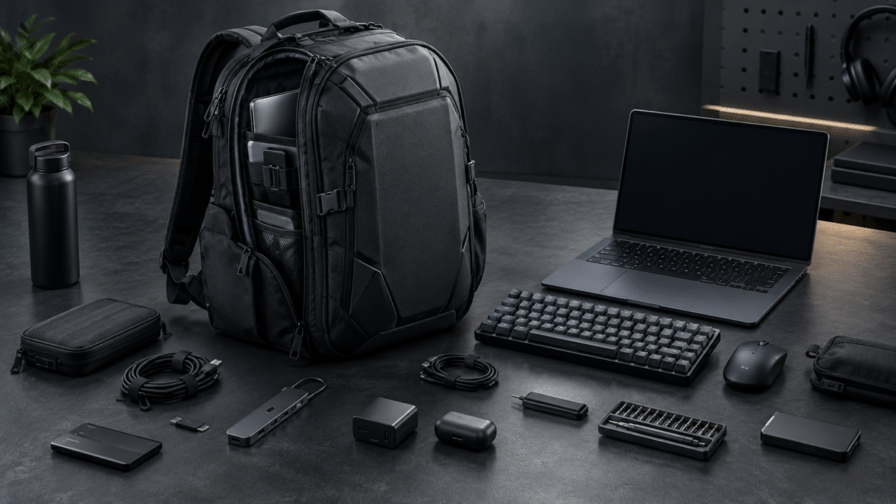
Besides replacing my HP, which had been flattened into a pancake, with a Lenovo I found at a monstrous discount, I decided to rebuy a lot of the accessories I’d been hauling around for years and had completely forgotten about: Bluetooth headphones, wired headphones, AirPods, a wired mouse, a Bluetooth mouse, two USB adapters, a USB-C charger, an external keyboard, a portable monitor, a docking station, and an assortment of pens and notebooks I’d been carrying since university.
Then I asked myself how much of it I actually needed, especially now that I work fully remote and no longer trudge from client to client like in a galaxy far, far away.
I had a vision of Saint Francis, played by Mickey Rourke, running naked through the meadows and hymning the joys of freedom. I made a clean sweep.
I took my 30 L backpack, the one I use for long trips, put in the charger and nothing else, and solemnly slid the new laptop into the reinforced compartment like King Arthur sheathing Excalibur. Then I went to zip it shut, ready for another perilous journey, and realized the tragedy: the Lenovo is bigger than my old laptop, and the zipper would not close.
Once I finally accepted that, under the laws of physics as we know them, that laptop was not going into that bag, I resigned myself to spending more money on a new backpack. First, though, I did a little research. As usual, I followed the white rabbit down the hole.
A laptop backpack is much more than a container. For anyone who moves daily between home, office, campus, and travel, it’s an extension of your workspace. It has to protect the computer, hold the charger and accessories, be comfortable to carry, and above all suit how you get around.
The perfect backpack for someone who drives every day may be (in fact, is) a poor fit for someone riding a scooter for 10 kilometers (6 miles). And a tough, roomy pack can be pointless if all you carry is a 1.2 kg (2.6 lb) ultrabook from the car to the desk.
So the whole search began with one simple question: how much am I carrying, and how am I carrying it?
Size: it’s not just about the laptop
The first thing to check is obviously the laptop’s dimensions.
A 13″ or 14″ laptop fits in a relatively compact bag, while a 15.6″ or 16″ needs a bigger compartment. But choosing a backpack based only on screen size is a common mistake, and I made it too.
Two laptops that are both “15.6 inches” can have noticeably different outer dimensions. On top of that, you need room for the charger, mouse, documents, headphones, power bank, water bottle, and everything else.
For daily use, 15 to 25 liters is usually enough for a laptop and the essentials. The hard part is agreeing on what counts as essential, to quote Saint-Exupéry again. Moving up to 25-30 liters gets you a more versatile category, suited to people who also carry clothes, lunch, documents, or extra gear.
Above 30 liters you’re in travel-pack or “full-load commuter” territory. That doesn’t make those bags better. It just means more space, with the side effect that, thanks to Parkinson’s law, you may end up hauling cooking pots and pickaxes like a hobbit on a quest.
A good rule: pick the volume for what you normally carry, not for what you might need once a year.
A huge backpack used every day tends to fill up. More volume means more weight.
How heavy should a laptop backpack be?
Here you need to distinguish between the empty weight and the loaded weight.
This matters, and it’s often counterintuitive. A 1.5 kg (3.3 lb) backpack can feel light when you pick it up in a store. But put this inside:
- laptop: 1.5 kg (3.3 lb);
- charger: 400 g (14 oz);
- mouse: 100 g (3.5 oz);
- headphones: 300 g (10.5 oz);
- water bottle: 500 g (1.1 lb);
- documents and other accessories: 500 g (1.1 lb);
and you’re already at about 4.8 kg (10.6 lb). It isn’t hard to reach 6-7 kg (13-15 lb) on a working day.
From an ergonomic standpoint, several guidelines recommend keeping the load fairly modest. The University of California’s Ergonomics Program suggests roughly 15% of body weight as a reference, and other sources are more conservative, suggesting about 10%.
Don’t read these percentages as a universal threshold beyond which a backpack automatically becomes “dangerous.” Carrying time, distance, weight distribution, posture, and the design of the pack all matter too.
For an adult walking from the car to the office, 5-6 kg (11-13 lb) is manageable. If you carry those 5-6 kg on foot for half an hour every morning and evening, the difference is significant.
The practical rule: the more time you spend with the pack on your shoulders, the more it pays to invest in lightness and ergonomics.
So is a lighter backpack always better?
Spoiler: no.
An extremely light pack may sacrifice padding, structure, water resistance, and laptop protection. The goal isn’t the lightest bag possible but the best compromise between weight, protection, and comfort.
For normal professional use, an empty weight of around 0.8-1.3 kg (1.8-2.9 lb) is a good compromise. A pack of 1.5 kg or more can make sense when it offers something special: extra protection, very tough materials, a rigid structure, technical compartments, or large capacity.
Conversely, if all you’re carrying is an ultrabook, a charger, and a few accessories, lugging around a heavy reinforced pack may not make much sense.
When is a reinforced backpack worth it?
A reinforced pack gets interesting when your laptop is exposed to impacts, drops, compression, or harsh conditions. (No backpack would have saved my laptop from an encounter with cars, unless I’d owned a Panasonic Toughbook. My CEO at a previous job once slammed one on the floor to demonstrate its toughness to a room full of army generals. Unfortunately, he chipped the marble floor. One of the most violent presentations I’ve ever witnessed.)
But back to backpacks. The first thing to look at is the laptop compartment.
It shouldn’t be just a fabric pocket. You want a padded compartment, ideally raised off the bottom of the pack and protected on the sides too.
That’s because when a backpack hits the floor, the laptop doesn’t necessarily take a direct hit. The impact travels through the base and the structure of the bag.
Good protection should include:
- a padded base;
- protected side walls;
- a dedicated laptop divider;
- a secure closure;
- a reasonably stable structure;
- an abrasion-resistant outer material;
- water protection.
That last point matters especially if you get around on foot, by bike, or by motorcycle or scooter.
Waterproof or water-resistant?
They’re two different things.
A water-resistant backpack can protect its contents from light rain and splashes. A truly waterproof one is designed to keep water out even under heavier exposure.
For a house-car-office commute, water resistance is generally enough.
If you ride a motorcycle or scooter every day, things change. You want a bag with very water-resistant construction, protected zippers, and ideally a rain cover or fully waterproof build.
The reason is simple: on a bike you’re not just walking in the rain. Speed increases the pressure of the water against the pack and makes it harder to keep the contents dry. And I’m writing this the day after the first storm of September uprooted trees and flooded underpasses.
Laptop backpacks for drivers: practicality first
If you mostly commute by car, your protection needs are fairly simple.
The laptop spends most of its time on a seat, in the trunk, or on a desk. The biggest risk isn’t prolonged rain or a fall while driving. It’s the walk between the parking lot and your destination.
In this case I’d choose a backpack that is:
- lightweight;
- compact;
- equipped with a padded compartment;
- well organized inside;
- easy to open;
- water-resistant;
- possibly fitted with a strap to slide over a rolling suitcase handle.
You don’t need the toughest model on the market. In fact, for daily drivers, an 18-24 liter pack can be more comfortable than a 30-35 liter one.
The main benefit is organization: laptop in one compartment, charger in another, and documents, keys, and small items within easy reach.
Laptop backpacks for bus and metro: comfort above all
Buses, trams, and subways change the picture completely.
If you use public transport often, you carry the pack for longer stretches, often standing, walking between stops and stations, and hopping on and off quickly.
Here the shoulder straps become essential. They should be:
- wide;
- padded;
- adjustable;
- well connected to the frame of the bag.
It’s also important to wear the pack on both shoulders. Ergonomic guidance recommends avoiding one-shoulder carrying, because the asymmetric load can increase stress on your back and shoulders.
The position of the laptop matters too. Heavier items should sit close to your back, which reduces the leverage pulling you backward. These may sound like trivialities, but load organization deserves your attention even if you’re not a container ship. (And don’t get me started on the damage caused by sitting on a wallet in your back pocket.)
For the daily bus and metro commuter, then, I’d go for comfort over extreme toughness. A well-organized 20-25 liter pack with good structure is probably the most balanced solution. A quick-access pocket for a book or e-reader is a nice bonus, because thinking while riding the subway is extremely dangerous.
What if you ride a motorcycle or scooter?
A motorcycle backpack shouldn’t be treated as just a “tougher laptop backpack.”
In a crash, completely different requirements come into play.
There are backpacks designed specifically for riders, with compartments for back protectors certified to EN 1621-2 (the European standard for motorcycle back protectors). Some models also combine waterproofing, reflective elements, chest and waist straps, and a laptop sleeve. This kind of product can make a lot of sense if you ride daily, adding real value at no extra cost.
But be careful: a regular reinforced backpack is not the same as a certified motorcycle back protector.
If rider safety is the priority, your spine protection should come from a device designed and certified for that purpose. Back protectors conforming to EN 1621-2 undergo specific impact-absorption tests, and Level 2 allows a lower average transmitted force than Level 1.
So for riders, the ideal solution isn’t necessarily a hard-shell pack. It’s better to look for one designed for motorcycle use, with:
- a stable fit on the body;
- a chest strap;
- optionally a waist belt;
- abrasion-resistant materials;
- good back ventilation;
- reflective elements;
- rain protection;
- a padded laptop compartment;
- provision for a certified back protector, where available.
And above all, avoid overloading it. While riding, a bulky, heavy load becomes uncomfortable and hurts your comfort, especially on longer trips.
How big should a motorcycle backpack be?
It depends on how you use it.
For home-office, with a laptop, charger, and a few small accessories, 18-25 liters can be enough. If you add lunch, rain gear, gloves, documents, and other items, you can go up to 25-30 liters. Beyond that, ask yourself whether you really need to carry everything on your back. For longer trips, you may be better off with luggage fixed to the bike and keeping only what you truly need in the pack. (Which brings us to the wonderful world of the top case, sometimes too small to hold a laptop and all its trappings.)
Laptop protection isn’t just about padding
A common mistake is assuming “more padding = more protection.” Not necessarily. The quality of protection also depends on the overall construction of the bag.
Picture two models. The first has an enormous amount of foam, but the laptop rests directly on the bottom. The second has less padding, but the laptop compartment is suspended and separated from the base. In a fall, the second one may offer smarter protection.
That’s why, when buying a laptop backpack, it pays to check the bottom of the laptop compartment above all. The laptop should never touch the base of the bag directly. If I have room, I add a bit of bubble wrap in the compartment, even though I know that at the moment of impact it will surely be in the wrong place.
And if you fly often?
Even if the main purpose of your backpack is daily work, many people use it as a personal item when traveling. In that case, size matters even more.
There’s no universal size that works for every airline. Rules depend on the carrier, the fare, and the type of bag. In 2026, for example, personal items are commonly around 40 × 30 × 20 cm (16 × 12 × 8 in), while cabin bags are frequently in the range of 55 × 40 × 20-23 cm (22 × 16 × 8-9 in). If you want to use the same backpack for work and travel, always check the rules of the airline you fly with. I could sacrifice my toothbrush and swimsuit, but if anyone tries to put my laptop in the hold, plenty of alarms will go off.
And pay attention: the capacity in liters isn’t what counts. The outside dimensions of the pack when full are what count. A compressible 25-liter bag can be far more practical than a rigid, boxy 25-liter one.
A quick-pick table
| Use | Suggested capacity | Priorities | Reinforcement |
|---|---|---|---|
| Car + office | 15-22 L | Lightness and organization | Medium |
| Daily bus/metro | 18-25 L | Comfort and ergonomics | Medium |
| Motorcycle + office | 18-25 L | Stability, waterproofing, safety | High |
| Motorcycle + lots of gear | 25-30 L | Durability and load distribution | High |
| Business trip | 20-30 L | Organization and dimensions | Medium/high |
| Laptop + lots of accessories | 25-30 L | Capacity and structure | High |
Of course, these are general guidelines: your laptop, your build, your health, and how much you actually carry can change the choice completely.
The real question: how often will you wear it?
This is probably the most useful criterion of all. If you carry the pack for five minutes from the car to the office, strap comfort matters relatively little. If you wear it for an hour a day on public transport, it becomes one of the key features. If you ride a motorcycle, stability, waterproofing, visibility, and compatibility with protective gear all come into play.
So let’s picture three profiles.
The dev who drives
Needs a light, tidy pack. Not necessarily huge, not necessarily heavily reinforced.
Ideal choice: about 18-22 liters, low weight, a well-padded laptop compartment, and good organization.
The dev on public transport
Needs comfort and good weight distribution.
Ideal choice: about 20-25 liters, padded straps, a comfortable back panel, good adjustability, a protected laptop compartment, and a quick-access pocket for a book or e-reader.
The dev on a motorcycle or scooter
Needs toughness, waterproofing, and stability, in addition to rider protection.
Ideal choice: about 20-25 liters, sturdy construction, reflective elements, a chest strap, and, where possible, provision for a certified back protector. Also make sure you have space for your phone and the other things you usually keep in your pockets. Before losing my backpack, I scattered a Nokia and a BlackBerry along the ring road, and the Nokia 3310 turned out to be less indestructible than urban legend claims.
In conclusion: the best backpack isn’t the biggest one
When you shop for a laptop backpack, it’s easy to be swayed by the number of pockets, the liters of capacity, or the amount of padding. In reality, the best choice is almost always the balanced one. Your laptop needs good protection and a compartment that fits it. Your body needs a reasonable load. If you walk a lot, you need ergonomics and good load distribution. If you ride, you need waterproofing, stability, and above all certified protective gear when it comes to impact safety.
The ideal capacity, in most cases, falls between 18 and 25 liters. Going up to 30 liters makes sense if you regularly carry more stuff, while dropping below 18 can be perfect if you carry only a laptop, a charger, and a few accessories.
Weight deserves careful thought too. A light empty pack leaves more headroom for the laptop and everything else you’ll carry through the day. Ergonomic recommendations also urge keeping the total load as low as possible, with reference figures often around 10-15% of body weight, and always avoiding unnecessary loads.
Before you choose a laptop backpack, it pays to answer four questions:
Which laptop do I need to carry? How much does all my gear weigh? How long will I spend with the pack on my shoulders? And how will I be getting around?
The answers are worth far more than the words “professional backpack” printed in big letters on the label.