
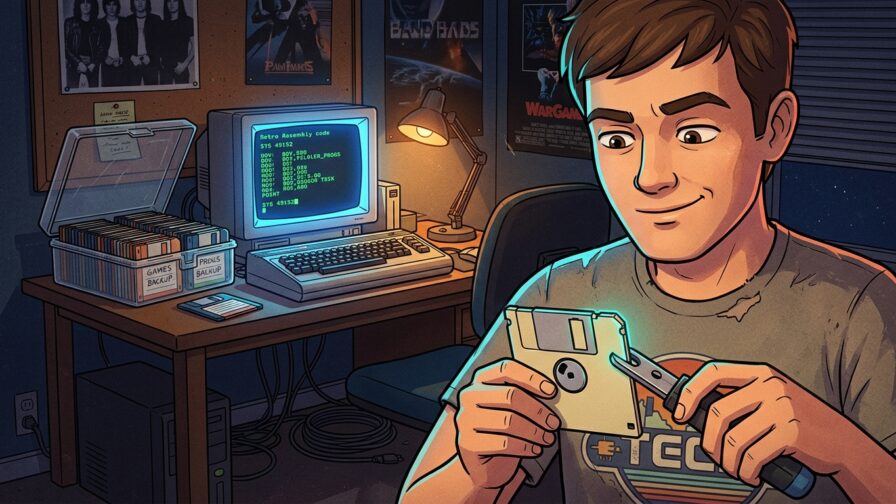
In my fifty-something mind, the term “nerd” has always been linked to a precise concept: the classic geek profile, with an isolated social life and a visceral passion for computer science, mathematics, and sciences: someone who solved equations for the pure pleasure of doing so, read Asimov under the desk, and spent afternoons or nights taking apart and rebuilding computers, writing code, hosting copy parties with floppy disks, and discussing computer science.
What happened next? Within a single generation, the word “nerd” slipped away from the world of hardcore computer science and hacker ingenuity to define a universe made of pop consumption, cosplay shows, and branded t-shirts. But what exactly happened to the original meaning?


The original equation and the myth of programming “crews”
If we run a git log (yes, this is a very nerdy concept) of our youth culture going back to the ’70s and ’80s, before the advent of social media and fast fashion, the word “nerd” corresponded to a precise, visceral, and totally tech-oriented concept.
Being a nerd was not an aesthetic pose or an Instagram bio. It was a total immersion in computer science, mathematics, or sciences.
And mind you: the computer was just one of the entry points. The nerd of back then was also whoever competed in math olympiads, kept a chemistry kit in the basement, built their own amplifier following the schematics of Nuova Elettronica, or pointed a telescope from their balcony. The lowest common denominator wasn’t the programming language, but the hunger to understand how things work. I entered through the door of computer science, and from there on I will tell that story, but the concept was much broader.
In the ’80s and ’90s, those who wrote code did not work in sterile isolation: my crew and I (shoutout to Skyfox and Ian Coog) gathered on a rotating basis in someone’s bedroom. We proudly showed up with our hard cases full of floppy disks, and spent nights copying files while listening to the epic screeching of cassettes from a Commodore 64, an Amiga 500, or early PCs with green phosphor monitors (I also worked with red plasma monitors, but I’ll stay humble).
I still remember the Commodore stand at SMAU 90, or thereabouts, where all floppy drives were locked against disk insertion, but some enterprising mind had brought a wire cutter from home to remove the lock and load their own stuff. There were two rows of computers inside a tunnel, and when you entered you were catapulted into a world of lights and sounds, with people passing disks and exchanging tricks and code.
And do you remember the apex of maker ingenuity at the time? Taking a punch, scissors, or a file to make a hole on the side of a floppy disk to magically double its storage capacity! Those were the days of the demoscene, copy parties, and BBSs run over a 56k modem.
Crews challenged each other with Assembly code to squeeze every last clock cycle out of a 1 MHz processor, creating vector graphic intros, chiptune music, and incredible register routines. There was a spirit of pure engineering alliance: the concept of “nerd” was synonymous with those who programmed together for the sheer pleasure of mastering the machine.
The first pop era: from “Revenge of the Nerds” to the personal computer
Cinema in the ’80s was the first to codify this human profile on the big screen. Who among us, with a few more years on our shoulders, hasn’t watched “Revenge of the Nerds” at least once?
A group of nerds, lovers of mathematics and computer science, gathered under the umbrella of the Lambda Lambda Lambda fraternity. A group that welcomed people who were marginalized, bullied, and mocked by the rest of the college, but eventually managed to turn the tables thanks to ingenuity and technology: it motivated more people in that movie than all of Steve Jobs’ motivational speeches combined.
And cinema in those years didn’t just celebrate those who programmed. There was the character of David in “WarGames”, who almost triggered World War III with a modem and an acoustic coupler, and above all there was Doc in “Back to the Future”: crazy hair, a garage full of inventions, and a DeLorean transformed into a time machine. The quirky scientific genius was just as much a nerd archetype as that of someone hacking away at a keyboard.
In that historical period, the concept linked to the term was still science and computer science lived as an all-consuming passion. Compiling source code, configuring an expansion board, or understanding a circuit required a massive intellectual effort, completely devoid of any commercial or romantic appeal.
The economic revolution: when code conquered Wall Street
In the ’90s, the first major shift occurred. The explosion of the World Wide Web and the rise of Silicon Valley suddenly showed the world that knowing how to write code was the most strategic skill on the planet.
Pioneers like Bill Gates, Steve Wozniak, and Linus Torvalds transformed the server room from a place of punishment to the control room of the global economy.
Those who administered systems (sysadmins), previously mocked and marginalized figures, were now leading the charge from cyberspace. Managing Linux kernels, administering IRC channels, and information security became the most sought-after and well-paid professions.
However, until the early 2000s, those working in IT were seen as useful and well-compensated, but the concept of “nerd” remained strictly anchored to technical skill and intellectual eccentricity.
The turning point: Seth Cohen and the invention of “geek chic”
Talking to my wife, who, unlike me, is heavily influenced by 2000s culture, I noticed how the term “nerd” underwent a cultural transformation. The exact moment the meaning of the term began to slide toward another concept was August 2003, when the character of Seth Cohen arrived on TV in the show “The O.C.”.
For those born in the ’70s, “The O.C.” is nothing but a puddle in the road, but for those born in the ’80s and ’90s, Seth Cohen was a real cultural watershed.
Despite loving Marvel comics, “Star Wars” science fiction, and indie music, Seth did not embody the stereotype of someone writing code in a sloppy way, locked in a basement with questionable personal hygiene, but was instead a brilliant figure, endowed with an irresistible sarcasm and incredibly desirable.
Seth brought geek culture mainstream on television, ushering in the “adorkable” (a blend of “adorable” and “dork”) nerd stereotype and effectively making it “cool” and attractive.
For the first time in mainstream television history, the icon of the attractive protagonist was no longer the athletic and brooding figure, but rather the outsider with passions for cultural niches. Seth Cohen brought the term “nerd” into the mainstream, making it attractive, funny, and “cool” (or “un figo”, as we used to say back then). On one hand, we must recognize that this mainstreaming of nerd culture removed the social stigma that isolated those who programmed thirty years ago, making technology and programming accessible to anyone. On the other hand, it unwittingly triggered the progressive decoupling of the term from those who unconditionally loved science to shift it toward the consumption of pop culture.
The last stand: “The Big Bang Theory”
Truth be told, between Seth Cohen and TikTok, there was one last bastion of the original concept: “The Big Bang Theory”. For twelve seasons, from 2007 to 2019, the most famous nerd figures on the planet were not linked to the world of programming or cosplay, but to scientific studies at Caltech.
Sheldon, Leonard, Howard, and Raj loved comics and costumes, sure, but their identity was built on science: blackboards full of equations, debates on string theory, and the veneration of Feynman and Hawking. They embodied the concept I have in mind much better than any cosplaying influencer: pure passion for science, brought to primetime with all its obsessions and social awkwardness.
I confess without shame: I worshiped the episode where Sheldon meets Stephen Hawking, and in the summer I walk around in an old t-shirt with “Bazinga” printed on it, and every time I wear it I feel part of that tribe much more than of any modern fandom, despite the sarcastic jabs I get from my kids.
The disruption in a generation: from one concept to another
Within thirty years, we have witnessed a true semantic transition. The term “nerd” wasn’t simply forgotten: it was reassigned to a completely different concept.
The contrast between what the word meant thirty years ago and what it means today is glaring:
- Yesterday’s concept: whoever embodied the term nerd would take a floppy, make a hole on the side with a file to double its capacity, prove a theorem for the sheer joy of doing so, build a radio with a soldering iron, love the computers they used to bring their ideas to life, and spend nights or afternoons copying floppies at their group’s house.
- Today’s concept: whoever defines themselves as a nerd gets their name written in Japanese ideograms on their arm, thinking it’s an epic choice, only to discover three years later that the text on their bicep literally means “pimple butt”, while parading at Lucca Comics dressed as a My Little Pony or Son Goku to gather likes on TikTok.
The AI crossroads: who inherits the original concept
If the word “nerd” has changed owners and been assigned to the world of fandoms and costumes, what happened to the original attitude of those who programmed in crews?
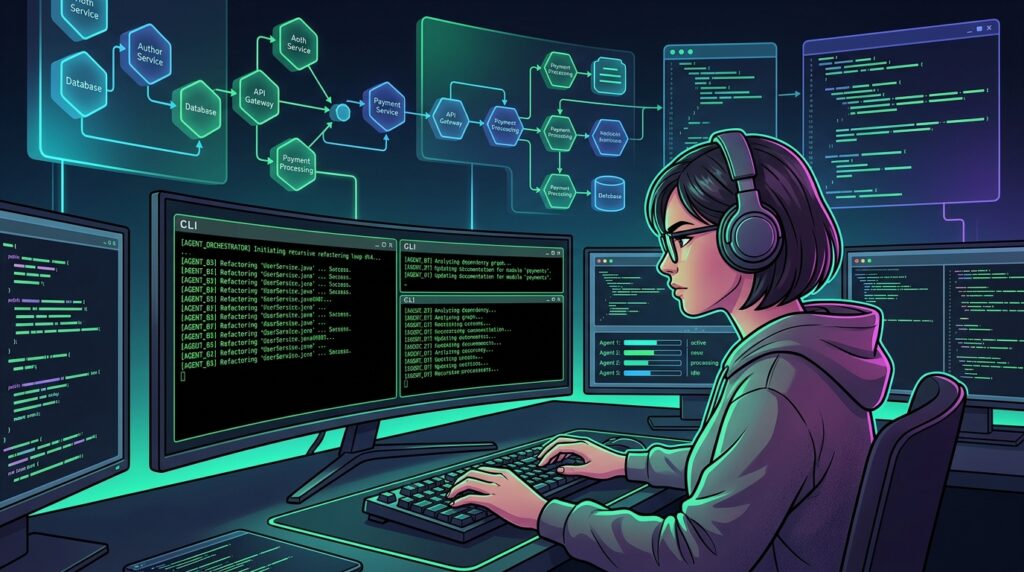
Faced with the generative AI revolution, the landscape has finally cleared up:
- On one side, we find the new meaning of the term, i.e., those who limit themselves to wearing Son Goku’s wig or a Kamehameha t-shirt bought at downtown shops, using AI at most to generate memes on TikTok or automated responses on social media.
- On the other side are we, those who guard the old concept, which has now been vaporized. And we aren’t just talking about software developers: there are machine learning professionals, data scientists, participants in mathematics and informatics olympiads, and makers who solder IoT boards. We who today build “agentic recursive loops”, connect microservices and LLMs via APIs, automate development workflows with sub-agents via CLI, and make heterogeneous hardware (from IoT boards and FPGAs to cloud clusters) interact with advanced prompt engineering and custom code.
I know that put this way it sounds a bit funny, bordering on cringe, but the reality is that the original concept of nerd has evolved into a new form: as a development community, we should reclaim this term, but unfortunately the word “nerd” now belongs to the pop world.
Critical analysis: semantic mutation and the future
As a development community, this semantic shift in a single generation forces four key reflections upon us:
What did we get wrong over the years?
We let things be emptied of their technical meaning to become a commercial label. Marketing figured out that selling the shell (the logo t-shirt, the mask, the gadget) was infinitely more profitable than explaining the content (the source code, the logic, the engineering).
Making pop culture explode was easier than explaining the complexity of code and hardware.
Can we put things back in place?
Rewinding the tape of language is almost impossible: when a word changes meaning in the collective imagination of a generation, trying to chase down the old definition is a lost battle.
Remember the meaning of “hacker”? The term went from the bright side to the dark side, and now it’s ruined forever.
The word “nerd” suffered the same fate: its original meaning has been completely replaced by a pop concept, and we cannot go back. However, we can continue to defend the value of engineering and technological creation.
Is it time to use a new word?
Yes, because the word “nerd” now officially defines the second concept (fandom, cosplay, pop media). To define the first, more romantic concept, our community has long used its true terms: “Hacker”, “Coder”, “Maker”, “Dev”, or our very Italian “Smanettone” (tinkerer).
However, there is a detail that none of these labels solve: they only cover those who program or tinker. There is no word for someone who, at fifteen, loves physics, proves theorems for fun, or spends evenings at the telescope. And it is the definitive proof that the original concept of nerd was broader than any term we try to replace it with today.
Two concepts, two different paths
The evolution of the word “nerd” in a single generation is an extraordinary linguistic and social case study. We didn’t lose a culture: simply, a word migrated from the classic concept linked to ingenuity, science, mathematics, computers, and programming, to that of pop consumption and entertainment.
Let the new generation use the word “nerd” to dress up as Son Goku or get tattoos whose meaning they don’t know. We will continue to embody the original concept: opening the terminal, fitting pieces of hardware together, making software and AI agents talk, writing or having code written that moves the world, and continuing to wonder how the universe works, equation after equation.
It's not important to be a nerd, it's important to be yourselfCode language: JavaScript (javascript)