
School’s out, which means it’s bonus season — and if your kid cleared a decent GPA, or if you’ve learned to interpret their report card’s deliberately cryptic teacher comments charitably, it’s time to open the wallet and prove your legendary generosity.
Convenient timing: the World Cup just kicked off, and every kid on the planet wants to be part of the biggest tournament in football. They’ve been watching the matches on TV and they want a piece of it.


What remains after you’ve ruled out the national team jersey — either because your country didn’t qualify or because the official kit costs roughly the same as a weekend away — is the official match ball. The Trionda. Which is not just a ball. It’s a hardware hacker’s fever dream.
The name packs in the number three (a nod to the three host nations) while “onda” is a loose reference to the wave — as in the stadium wave, la ola. Northern European marketing departments are not exactly known for their product naming instincts. Adidas can only get people to remember certain shoe models by attaching a tennis player’s name to them. IKEA built an entire call centre just so people could phone in and ask how to pronounce things.
On the engineering side, though? Absolutely ruthless.
The Trionda is the result of a collaboration between Adidas, FIFA, and Kinexon — a German company specialising in high-precision localisation systems and real-time analytics. If you haven’t heard of Kinexon, that’s not surprising: until a few years ago they were best known in industrial automation and logistics, developing platforms to track objects, machinery, and people with characteristically German precision. These days their technology runs across professional sports, from handball to basketball to the biggest international football tournaments.
The engineering problem nobody talks about
Putting electronics inside a football means solving several engineering problems simultaneously.
A regulation match ball weighs between 410 and 450 grams. Shift that mass distribution by even a few grams and you’ve changed the aerodynamics — trajectory, spin, bounce. The electronic module has to be incredibly light, perfectly balanced, and positioned at exactly the point where its weight becomes imperceptible to players.
But weight is actually the easy part.
During a match, a ball can reach speeds above 150 km/h. Some corners of the internet claim the hardest recorded shot hit around 211 km/h, though the sources are sketchy. Every strike produces violent accelerations that propagate through the ball’s structure. The electronic module has to survive thousands of consecutive impacts without losing sensor calibration, without dropping data transmission, and without throwing off the sphere’s balance.
This is why the project took years of materials research, internal component layout work, and electronics miniaturisation. The goal wasn’t just to build a “smart” ball — it was to build an imperceptible one. No player should notice the chip. The ball has to feel exactly like a standard FIFA-certified match ball.
Before any of this reaches a stadium, every prototype goes through wind tunnel aerodynamic testing, numerical simulations, and mechanical trials that replicate thousands of consecutive impacts. Every panel is analysed for deformation, elasticity, and behaviour under rain, humidity, and temperature variation. Adding electronics introduces new parameters to control: the sensor module has to keep working after hundreds of high-energy strikes. The battery can’t shift. The radio antenna has to maintain stable transmission regardless of the ball’s orientation mid-flight. Even the material surrounding the sensor is engineered to absorb some of the vibration from impacts.
From an embedded engineering standpoint, the Trionda is one of the most extreme examples of rugged electronics design you’ll find: a device that has to keep operating under prohibitive mechanical conditions with zero possibility of maintenance during a match.
A project that started long before 2026
FIFA had already introduced an internal sensor in the Al Rihla ball used at the 2022 Qatar World Cup. That experiment’s success pushed FIFA and Adidas to continue down the same path — refining hardware, firmware, and algorithms through to the Trionda.
Four years in tech is geological time. The entire chain improved in the meantime: more reliable radio transmission, more accurate time synchronisation, lower latency, and better integration with the computer vision systems already deployed inside modern stadiums.
If you caught the Amazon Prime coverage, their X-ray mode already gave you a taste of what this data looks like overlaid on live footage — genuinely useful, and occasionally a lifesaver during the slower stretches of a group stage match.
Anatomy of the Trionda: what’s actually inside
Neither Adidas nor FIFA has published the full construction spec — and given that the 2022 Qatar ball sold around 6 million units while the Germany and Brazil editions moved roughly 15 million each, you can understand why they’re protective of the IP. The official brochure is available here. But based on publicly available information about Connected Ball Technology and the technical specs Kinexon has shared, the internal architecture can be reconstructed with reasonable accuracy.
The outer skin
The outermost layer is a high-performance TPU (Thermoplastic Polyurethane) coating. TPU is a go-to material in sports equipment because it combines elasticity, abrasion resistance, and waterproofing. During a match the ball is constantly scraped across the pitch, hit by studs, and exposed to wildly different weather conditions. The coating has to maintain its properties equally under the summer heat of Mexico City and a wet evening in Vancouver.
The surface isn’t smooth. The microtextures visible to the naked eye are there to control airflow around the ball — reducing turbulence and making trajectory more predictable.
The aerodynamics
The Trionda has only 4 panels — the fewest in World Cup history. That drastic reduction in seam lines fundamentally changes how air moves around the sphere. Wind tunnel studies reveal some genuinely unusual dynamics:
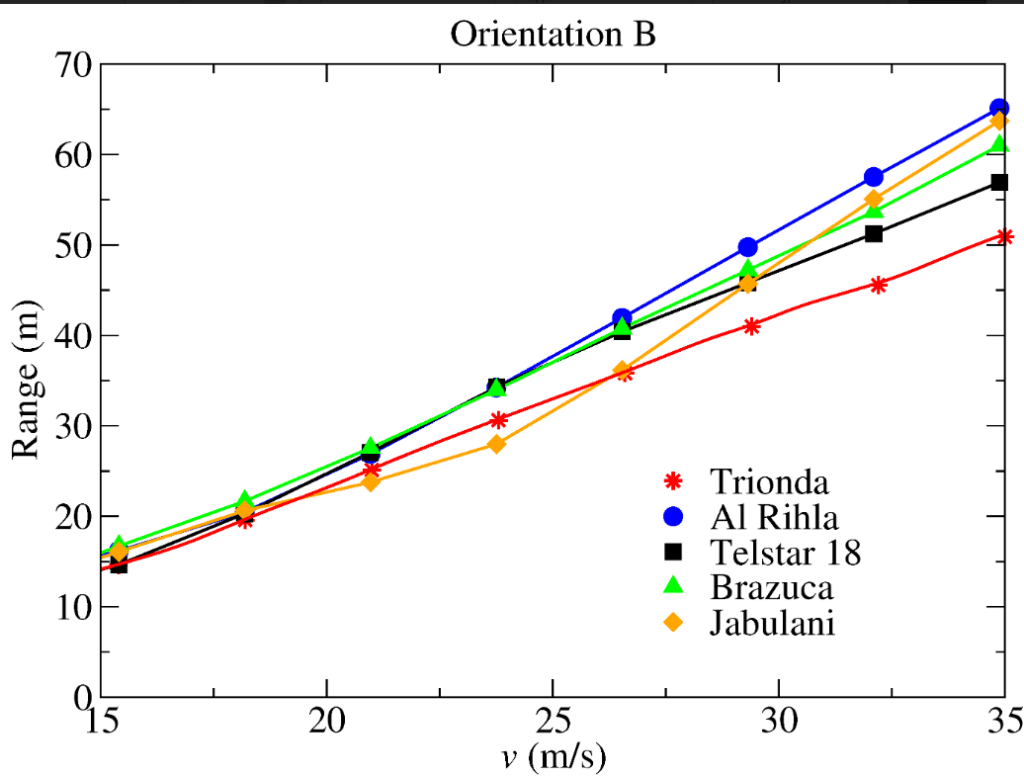
The drag crisis arrives early. In fluid dynamics, the drag crisis is the point at which airflow around the ball transitions from laminar to turbulent. Previous balls (like the Al Rihla or the Telstar 18) hit this transition somewhere between 50 and 65 km/h. The Trionda triggers it at around 43 km/h.
No more Jabulani effect. When a smooth ball decelerates sharply and airflow returns to laminar, the ball experiences unpredictable lateral forces — the infamous knuckleball that made goalkeepers look ridiculous with the 2010 Jabulani. By triggering turbulence earlier, at just 43 km/h, the Trionda maintains stable, predictable flight for almost its entire typical trajectory, particularly at the standard speeds of free kicks and crosses.
To compensate for the lack of seams (a side effect of having only 4 large panels), the Adidas design team — officially credited to the Italian division, according to company documents — added two corrective elements: deep debossed macro patterns along the panel edges, and micro-textures across the surface referencing the three host nations’ symbols (star, maple leaf, eagle). These work exactly like the dimples on a golf ball, gripping a thin layer of air against the sphere’s surface and reducing the low-pressure wake behind it.
The tradeoff: slightly more aerodynamic drag at high velocities. Long goalkeeper distributions and diagonal switches tend to lose a few metres of range compared to previous models, as the ball brakes and drops a little sooner.
Heat-bonded panels
Adidas eliminated traditional stitching some years ago. In the Trionda, panels are heat-bonded using high-precision industrial processes. No seams means better waterproofing — a stitched ball absorbs small amounts of water in wet conditions, subtly changing weight and dynamic behaviour. Heat bonding also delivers much more uniform tension distribution across the surface, which matters because any anomalous deformation would corrupt the internal sensor readings.
The bladder
At the centre sits the standard air bladder, designed to hold constant pressure throughout the match. The internal sensors operate assuming the ball has specific elastic characteristics, so pressure is controlled with extreme precision before every game. A significant pressure variation would affect not just ball behaviour during play, but the quality of every measurement the inertial platform produces.
The IMU
The real brain of the system is an Inertial Measurement Unit combined with an Ultra-Wideband (UWB) chip. If you build mobile or wearable applications, you know what an IMU is — it’s the same sensor family that tells your phone when it’s been rotated, tilted, or shaken. The context here is somewhat different. A phone might occasionally fall off a desk. This ball gets deliberately kicked, repeatedly, by professional athletes, plus collisions with goalposts, advertising boards, and crowd barriers.
The IMU integrates two sensor families:
Accelerometers measure acceleration along three spatial axes. When a player strikes the ball, the accelerometer registers an immediate acceleration spike. The event lasts only a few milliseconds, but that’s enough to determine the precise moment of contact — critical for offside detection, where you need to know exactly when the pass was played.
Gyroscopes measure angular velocity. They capture the spin imparted to the ball during a curling shot, a cross, or a header. Combined with the accelerometers, the system reconstructs the ball’s dynamic behaviour in effectively real time.
The firmware
The proprietary firmware processes and transmits data on 3D position, acceleration, and rotation 500 times per second (500 Hz). Its job: continuously read IMU data, filter out noise, time-synchronise measurements, and package everything for radio transmission. It’s optimised for minimal power consumption and minimum latency — a small real-time system running silently for the entire duration of the match.
The antenna
Once processed, data has to leave the ball. The integrated antenna transmits continuously to receivers installed around the pitch perimeter. Antenna design is one of the more interesting engineering challenges here: the ball rotates constantly, changes orientation hundreds of times per minute, is surrounded by player bodies, gets struck, deformed, and launched tens of metres — and through all of that, transmission has to remain stable and reliable.
Then there’s the UWB magic. Traditional radio systems (like 2.4 GHz Wi-Fi) transmit on a very narrow, continuous frequency. UWB transmits across an enormous spectrum (typically 3.1 GHz to 10.6 GHz), firing small pulses billions of times per second. That wide band means UWB doesn’t suffer from multipath interference — when radio waves bounce off stadium walls or spectators and create signal confusion. UWB pulses are short enough that the system distinguishes the direct impulse from reflected ones. And it doesn’t interfere with the 80,000 smartphones in the stands because it uses entirely different frequencies and transmission power levels.
Side note: the first official Adidas ball, used at Mexico 1970, was called the Telstar — named after a satellite launched in 1962, partly because it resembled one visually, and partly to celebrate the fact that it was the first World Cup broadcast via satellite. Some things come full circle.
The battery
FIFA and Adidas haven’t published full battery specs, but it’s known that the electronic module uses a rechargeable cell designed for well over 90 minutes of autonomy — accounting not just for the match itself, but pre-match warmup, extra time, a penalty shootout, and all the referee tests before kickoff. Before each game the ball is checked and recharged by kit staff. Adidas has released photos of the wireless charging dock but nothing more detailed yet — no USB ports in sight.
What happens if something fails? The system continuously monitors battery level, signal quality, and overall module health. If any parameter goes out of range, match officials are alerted immediately and the fourth official swaps the ball — exactly as happens today when a ball is physically damaged.
Like a modern smartphone, the Trionda follows a sealed-unit philosophy. The electronics are completely encapsulated inside the structure and not designed to be opened or repaired. Battery not replaceable, sensor not swappable, circuit board not accessible — without destroying the ball’s integrity and certifications. If the module fails, the ball is retired. It’s not the most sustainable approach on the surface, but it’s the only way to guarantee absolute precision, waterproofing, perfect balance, and reliability at the highest level of international competition.
Why any of this actually matters for VAR
Many people assume the ball sensor is primarily there to catch offside. Its most important job is actually something else: establishing with absolute precision the exact moment the ball is touched by a player.
That sounds like a detail. It’s not. That timestamp is what allows the Semi-Automated Offside Technology to perfectly synchronise ball data with the data collected from the dozens of cameras tracking player movement.
Video footage, however sophisticated, has unavoidable physical limits. Motion blur, signal compression, frame rate constraints — cameras capture a finite number of images per second. The inertial sensor directly detects the vibration produced by a boot striking the ball with millisecond-level precision, giving VAR a temporal reference far more accurate than anything video analysis alone could provide.
It’s this synchronisation between electronic data and camera images that has meaningfully reduced uncertainty in the most contested decisions. Whether it silences the Monday morning conspiracy theorists is another question. People believe what they want to believe.
What comes next
The 2030 World Cup may see balls capable of collecting data that seems unthinkable today. Beyond impact detection: instantaneous speed, ball rotation, the Magnus effect governing shot trajectory, surface temperature, internal pressure, structural deformation during a kick, even wear levels on the outer coating.
The most interesting direction is indirect biometric sensing. Without attaching any device to the players, a sufficiently smart ball could infer significant information just by analysing its own behaviour after each contact. Impact intensity, shot precision, the quality of the athletic gesture, even early signs of fatigue — all potentially estimated through AI models interpreting the ball’s own sensor data.
It sounds like science fiction. So did putting a computer inside a football, until recently.
Today it’s standard issue at a World Cup. Tomorrow it might be one of the most important tools for understanding the game, improving officiating, and supporting professional athlete training — the kind of thing that gets data analysts genuinely excited.
Because it helps separate the spectacle from what football actually is at its core. No sensors required for that part: four kids, a couple of bags for goalposts, and a battered ball. The offside rule, in that context, simply doesn’t exist.