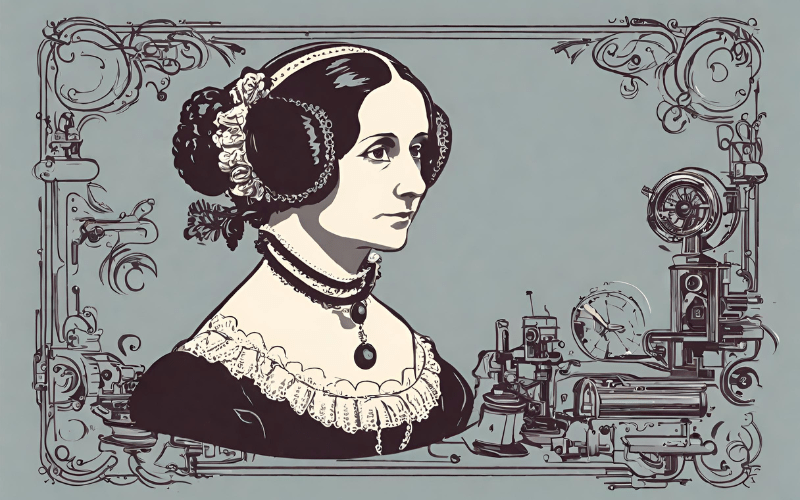
What if I told you the first person to imagine intelligent machines wasn’t a Silicon Valley founder, but a 19th-century aristocrat who never lived to see electricity?
In 1843, while most of humanity was still debating whether trains would make cows stop producing milk, Ada Lovelace wrote something extraordinary: notes on a theoretical computing machine that wouldn’t be built for another century. But here’s the kicker—she didn’t just describe what the machine could do. She imagined what it could become.
Today, as we wrestle with ChatGPT, Claude, and the explosive rise of generative AI, Ada’s insights feel less like historical curiosities and more like prophecies. She saw the potential for machines to create music, generate art, and transcend pure calculation—concepts we’re only now beginning to fully realize.


This isn’t a hagiography. Ada Lovelace wasn’t perfect, and her contributions were often overshadowed or misattributed. But understanding her work reveals something crucial: the questions we’re asking about AI in 2025 are the same questions she was asking in 1843. And maybe, just maybe, she already had some answers.
The World’s First Algorithm (And Why It Matters More Than You Think)
Let’s start with the facts. Ada Lovelace is widely recognized as having written the first computer algorithm—a set of instructions designed to be executed by Charles Babbage’s Analytical Engine, a mechanical computer that existed only on paper.
The algorithm itself calculated Bernoulli numbers, a sequence important in mathematics. But what made it revolutionary wasn’t the math—it was the thinking.
Ada’s algorithm included something no one had conceived before: conditional branching and loops. In modern terms, she invented the concept of an if-then statement and iteration. Without these, computers would be glorified calculators. With them, they became programmable machines capable of solving a theoretically infinite range of problems.
But here’s where it gets wild. Ada went further.
In her notes, she wrote:
“The Analytical Engine might act upon other things besides number… Supposing, for instance, that the fundamental relations of pitched sounds in the science of harmony and of musical composition were susceptible of such expression and adaptations, the engine might compose elaborate and scientific pieces of music of any degree of complexity or extent.”
Read that again. In 1843, Ada Lovelace predicted generative AI.
She didn’t just see computers as number crunchers. She envisioned them as creative engines—machines that could generate music, art, and content. Sound familiar? This is exactly what we’re doing with diffusion models, transformers, and neural networks today.
The parallel is uncanny. When DALL-E generates an image or GPT-4 writes a poem, they’re doing precisely what Ada imagined: taking abstract inputs, processing them through symbolic operations, and producing creative outputs. She called it 175 years before it happened.
The Poetical Science: When Math Meets Imagination
Ada’s mother, Lady Byron, was terrified that Ada would inherit the chaotic, poetic temperament of her father—Lord Byron, the infamous Romantic poet. So she did what any concerned aristocrat would do in the 1820s: she forced Ada to study mathematics as an antidote to poetry.
Ironically, this created the perfect storm. Ada didn’t abandon poetry—she fused it with mathematics. She called her approach “poetical science,” a synthesis of rigorous logic and imaginative thinking.
This mindset is exactly what modern AI development requires. The best AI researchers aren’t just mathematicians—they’re people who can imagine what doesn’t exist yet, then build the formal systems to make it real.
Ada’s genius was seeing beyond the literal. When Babbage saw his Analytical Engine as a calculation tool, Ada saw a general-purpose machine—a concept so advanced that it took nearly a century for Alan Turing to formalize it with his Universal Turing Machine.
In AI terms, Ada understood what we now call transfer learning and generalization: the idea that a system designed for one task can be repurposed for entirely different domains. She saw the Analytical Engine not as a single-purpose calculator, but as a flexible platform. Babbage built a hammer. Ada saw a toolbox.
The Limits of Machines: Ada’s Warning About “Artificial Intelligence”
Here’s where Ada gets really interesting—and where many modern AI enthusiasts should pay attention.
Ada wrote:
“The Analytical Engine has no pretensions whatever to originate anything. It can do whatever we know how to order it to perform.”
This is one of the most misunderstood statements in computing history. Some interpret it as Ada saying machines can never be creative. But read it carefully—she’s not saying machines can’t create. She’s saying they can’t create without instruction.
This is the exact debate we’re having today about large language models. Can ChatGPT “think”? Can Midjourney “create”? Or are they just executing sophisticated instructions based on training data?
Ada’s answer would likely be: both, and it doesn’t matter.
She understood that the boundary between execution and creation is blurrier than we think. When a machine composes music based on harmonic rules, is it creating or executing? When GPT-4 writes a novel sentence it’s never seen before, is that originality or sophisticated prediction?
Ada didn’t claim machines would never originate—she claimed they couldn’t do so at that time, given the constraints of her era. But she left the door open. She recognized that as our understanding of “ordering” became more sophisticated, so too would the capabilities of the machines.
In 2025, we’re still grappling with this. We don’t “program” GPT-4 in the traditional sense—we train it on billions of parameters and emergent behaviors arise. Is this fundamentally different from what Ada imagined? Or is it just a more sophisticated form of instruction?
The question remains unresolved. And Ada knew it would be.
Ada’s Legacy in the Age of Neural Networks
Today’s AI bears Ada’s fingerprints everywhere, even if most developers don’t realize it.
1. Algorithmic Thinking as a Foundation
Every machine learning pipeline—data preprocessing, model training, inference—is built on the kind of step-by-step, conditional logic Ada pioneered. Transformers don’t exist without loops. Neural networks don’t function without iteration. She invented the conceptual primitives.
2. Creative AI and Generative Models
The explosion of generative AI—GPT-4, Claude, Stable Diffusion, Sora—is the direct realization of Ada’s vision. She predicted machines that compose music (see: OpenAI’s Jukebox, Google’s MusicLM). She predicted machines that generate complex outputs from abstract inputs (see: literally every generative model).
3. The Ethics of Machine Responsibility
Ada worried about the misuse of machines. She emphasized the importance of understanding the tools we build. In 2025, as we debate AI alignment, bias in training data, and autonomous weapons, we’re asking the same questions Ada raised: Who is responsible when the machine acts? The creator, the user, or the machine itself?
4. Interdisciplinary Collaboration
Ada worked with Babbage, but she wasn’t just his assistant—she was his intellectual peer and often his superior in conceptualizing the machine’s potential. Modern AI breakthroughs happen at the intersection of computer science, neuroscience, linguistics, and philosophy. Ada understood that interdisciplinary thinking wasn’t optional—it was essential.
Why Ada Disappeared (And Why She’s Back)
For over a century, Ada Lovelace was largely forgotten. Babbage got the credit. The Analytical Engine became a footnote. Her notes were dismissed as exaggerations or misattributed to Babbage himself.
Why? The usual reasons: she was a woman in a male-dominated field, she died young (at 36), and her work was theoretical—it couldn’t be “proven” until computers actually existed.
But in the 1950s, when computers finally emerged, people started reading Ada’s notes. And they realized she’d been right about nearly everything.
The U.S. Department of Defense named a programming language Ada in her honor. Computer scientists began calling her the “first programmer.” And in the AI era, her work feels more relevant than ever.
Ada Lovelace Day (celebrated every second Tuesday of October) has become a rallying point for women in tech—a reminder that the field wasn’t built by men alone.
What Ada Would Think of Modern AI
If Ada could see GPT-4 generating poetry, Stable Diffusion creating art, or DeepMind’s AlphaGo defeating world champions, what would she say?
I’d bet she’d say: “I told you so.”
But she’d also ask the hard questions:
- Who decides what the machine creates? (Alignment)
- What happens when we don’t understand how it works? (Interpretability)
- Can a machine’s output ever be truly original? (The Creativity Problem)
- What are we losing when we delegate creativity to machines? (Human Obsolescence)
These are the questions driving AI research today. And Ada was asking them in 1843.
The Final Lesson: Vision Without Execution Is Worthless—But So Is Execution Without Vision
Ada never saw her algorithm run. Babbage never finished building the Analytical Engine. Her work existed purely in theory.
But that theory mattered. It shaped how future generations thought about machines. It planted seeds that Alan Turing, John von Neumann, and Grace Hopper would later cultivate.
In software development, we fetishize execution. Ship fast. Break things. Minimum viable product. And that’s important.
But Ada’s legacy reminds us that vision is the bottleneck. The world didn’t lack engineers in the 19th century—it lacked people who could imagine what didn’t exist yet.
Today, as we stand at the precipice of artificial general intelligence, we don’t need more people who can train models. We need people who can imagine what comes next.
We need more Ada Lovelaces.
Conclusion: The Programmer Who Saw Tomorrow
Ada Lovelace wasn’t just the first programmer. She was the first person to understand what programming could become.
She saw machines as partners, not servants. She saw code as creative expression, not mere instruction. She saw the future not as a fixed destination, but as a space of infinite possibility shaped by human imagination.
In 2025, as AI rewrites industries, challenges assumptions, and forces us to redefine intelligence itself, Ada’s work stands as both a foundation and a challenge.
We’ve built the machines she imagined. Now the question is: are we wise enough to use them the way she envisioned?
Or will we, like Babbage, get so lost in the engineering that we forget to ask why we’re building in the first place?
Ada Lovelace knew the answer. The machine is only as brilliant as the vision that drives it.
And vision, as always, is a human endeavor.