

This article explores the main highlights and key concepts of Scott Chacon’s “Why GitHub Won” speech at Codemotion Milan.
Only a few months have passed since Codemotion Milan 2025, and AI Agents—the latest and supposedly final buzzword of 2025—are already struggling to provide enough novelty to satisfy the ever-hungry armies of programmers.


But developers, as we know, are not all the same. Thanks to the Christmas holidays, I rewatched all eight Harry Potter movies at least twice each, and so I came up with a slightly contextualized classification.
There are those constantly searching for the Elder Wand, the solution that will allow their company to rise as the supreme house. I’ve witnessed their massive attendance at every deeply technical talk, eager to increase their know-how and cast their name into the Goblet of Fire.
Then there are those who skip even internal meetups in the hope of finding the Resurrection Stone: terrified by predictions of the “death of the programmer,” they are enrolling in beekeeping courses or researching how to become Folletto agents. The similarities between bees and agents give them, at least mentally, a sense of continuity.
Last, but my personal favorites, are the bearers of the Invisibility Cloak: those who have been assigned for 30 years to some mega-ministry and speak about innovation with sarcasm and irony, adding science-fiction details, debugging code written by Benedictine monks, and waiting months for approval to change a comma. They’ve learned the hard way that suggesting innovation in these environments means becoming the target of the Basilisk of “we’ve always done it this way.” Their ghost will be condemned to wander the women’s bathroom for eternity—or until retirement, two periods that recent reforms are making increasingly equivalent.
Thankfully, there are people like Chacon, who achieved success without the Deathly Hallows and occasionally take the stage to remind us that you can be a muggle to the core and still try. But what do we mean when we talk about technological success? Is it just about writing the best code, or is there a hidden variable—a “ghost in the machine”—that determines who wins and who loses?
The GitHub co-founder and central figure in the Open Source revolution offered an illuminating perspective, revealing not only how GitHub conquered the world, but also crucial predictions about how Artificial Intelligence (AI) and Large Language Models (LLMs) are about to rewrite the rules of the game, just as Git did fifteen years ago.
1. The Illusion of Competence and the Tyranny of Timing
One of the first lessons Scott dismantles with brutal honesty is the myth of the lone entrepreneurial genius. Looking back at billion-dollar companies like GitHub, we often rationalize success as the result of flawless strategy. Chacon is blunt: “Don’t pretend you knew what you were doing… actually, you know what? Apologize to the audience.”
There are no recipes. Success lies at the intersection of Good Taste (the product) and Timing (the market). While the product can be controlled, timing is almost impossible to predict.
Apple’s Newton versus the iPhone is a classic example. The Newton arrived too early and failed completely. The same ideas, introduced later with the iPhone, changed the world. Similarly, Nvidia took a decade to realize the market desperately needed its GPUs not just for gaming, but for AI.
For today’s founders and developers, we are living through a new moment of “astral alignment.” The AI wave represents a paradigm shift, like the rise of the Internet or mobile. The product doesn’t need to be perfect—it just needs to arrive exactly when the paradigm shifts.
2. Market Taxonomy: Who Will You Be in the AI Era?
Drawing on a reflection by Jensen Huang (CEO of Nvidia), Chacon outlines three types of companies:
- Market Makers: Companies like GitHub that define new markets.
- Share Takers: Those who improve and capture part of an existing market.
- Pavement Layers: Those who build foundational infrastructure where nothing existed.
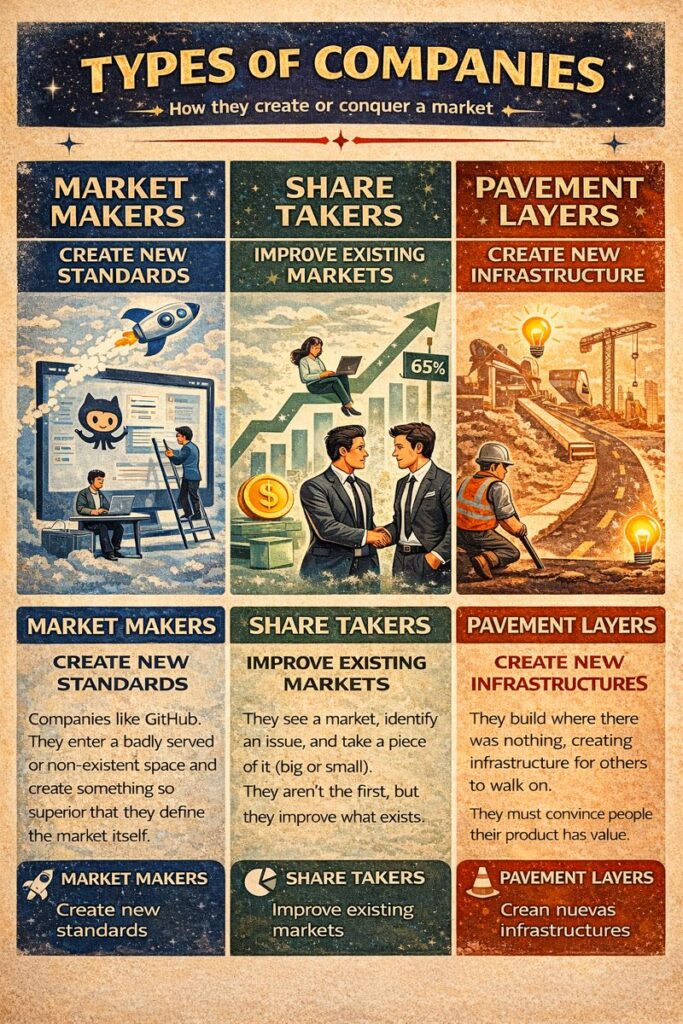
AI offers opportunities for all three, but true giants often emerge as Market Makers during paradigm shifts.
3. The Death (and Rebirth) of Open Source
Perhaps Chacon’s most provocative prediction concerns Open Source. For decades, the model was simple: don’t reinvent the wheel.
LLMs change this. “I think we’ll move toward asking an LLM to generate the 5% of a library we actually need, instead of importing something bloated.”
Implications include:
- Shrinking communities
- Changing value of sharing
This isn’t the end of Open Source, but its evolution into the training substrate for intelligence.
4. The Developer of the Future: From Assembly to Prompts
AI won’t make developers obsolete. It raises the abstraction level.
“Developers won’t be so deep in the weeds. Everything will be at a higher level.”
LLMs are the new compilers.
5. The Paradox of Human Connection
Despite remote work and AI, in-person conferences matter more than ever.
“Finding people interested in the same problems is much harder online than in person.”
Human interaction becomes the real scarcity.
6. Historical Analysis: Why GitHub Won (and What It Teaches Us About AI)
GitHub removed friction at the exact moment Open Source exploded.
Today, AI is the new “Git.” Traditional programming is the new “Subversion.”
In short, these predictions are grounded in historical cycles, not speculation.
We are facing an “Epochal Change.”
- Software will become more bespoke, generated by AI.
- Developers will evolve toward architecture and supervision.
- Timing will be decisive.
As Chacon says, “You couldn’t build Uber before the iPhone.”
The companies that will define our future are being born right now.