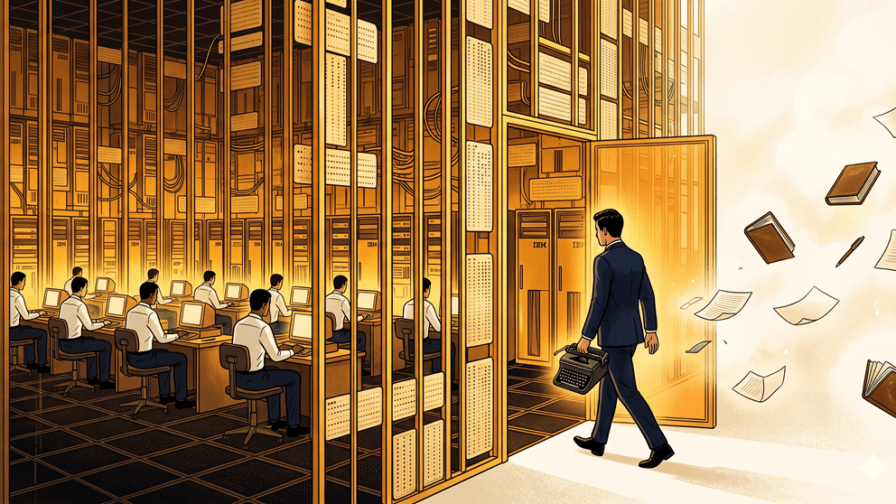
Recently I came across this passage from Luciano De Crescenzo’s book “Order and Disorder”, which recounts a pivotal moment in his life, when he decided to leave his job as a software engineer at IBM to dedicate himself to writing.
When I decided to stop being a computer engineer and become a full-time writer,
I went to Segrate, to IBM's general headquarters, to communicate my decision to
those in charge. It was May 7, 1978. Well, I confess: being Neapolitan, and
therefore prone to tears, I was rather moved. I looked like a high school student
who had to say goodbye to his first love.
Once I left the big boss's office, I went downstairs to the open space on the
second floor, to see my former colleagues. I walked in and found them sitting
there, all three of them, each behind their own desk, just as I had seen them on
my first day in Milan. Giorgio, Ernesto and Stefano were still there, with their
paperwork in front of them, their block diagrams and their phones constantly
ringing. They looked at me in astonishment at the decision I had made. They
weren't speaking, but it was all too clear what they were thinking: "He's leaving
IBM to become a writer! He must have gone mad!"Code language: PHP (php)
This passage made me think: it was 1978, an era in which professional stability was considered a fundamental value. As a child, I still remember my father choosing to leave a job in Switzerland, working for someone else, for a government position. He was moving from a well-paid but unprotected role to one that would guarantee him security until retirement.
Re-reading these lines, I realized that De Crescenzo’s decision represented the exact opposite of my father’s path: a true act of courage and faith in one’s own passions.


At this point I asked myself: would it still be possible to make the same move today? How much have publishing and the tech industry changed in the meantime?
Let’s try to draw a comparison to understand what was happening in 1978 in the technology and literary sectors, what is happening today, and whether it is truly feasible to make the same choice in the present day.
Milan, 1978
De Crescenzo, then a rising executive at the Segrate headquarters, made that gesture not in a vacuum, but within a system of guarantees that today looks like the mirage of a lost civilization.
To understand the magnitude of De Crescenzo’s resignation, we need to understand what IBM represented in the 1970s.
It was not simply a company, but a supranational state, an entity that guaranteed its “citizens” total protection in exchange for absolute conformity. Working at IBM meant belonging to a technical aristocracy. The systems engineer was not a code executor, but an architect of complex solutions, the keeper of an esoteric body of knowledge (the by-now Jurassic mainframes) that drove the global economy.
The salary of a manager or engineer guaranteed immediate positioning in the upper echelons of the middle class. The pay scales in the Italian metalworking and industrial contracts of 1978, despite a context of high inflation, included wage indexation mechanisms (the so-called “scala mobile”) and an automatic career progression that has since disappeared.
An IBM engineer earned an income that, measured against the cost of living, allowed them to accumulate real estate wealth in an incredibly short time, at a speed unthinkable by today’s standards.
IBM represented an environment where technical merit was celebrated with near-academic honors. Being an “IBM Fellow” meant having unlimited research freedom and budgets, at least in the United States, a status that De Crescenzo walked away from, but which formed the psychological safety net of his choice: he knew he was highly valued in a market hungry for expertise. If the leap had gone badly, he could certainly have returned to a context that would have welcomed him with open arms.
Dress code
In the 1970s, corporate culture was dominated by the mandatory white shirt, dark suit and near-monastic sobriety. Looking at the photos from that era, they look more like wedding portraits than office snapshots. Anyone who spoke with an IBM technician found themselves face to face with someone who obsessively respected the company dress code. Today’s professionals, by contrast, have moved toward a more eccentric style, far removed from the obsession with the impeccable suit.
Along these lines, I recall that in the 1990s there was still a strong residue of this culture. There was a period in my life when, armed with my CV, a polished appearance and the chronic shortage of IT professionals, job interviews would often flip: it wasn’t me who had to describe myself, but the companies that had to sell themselves to convince me. In a sense, I used to my advantage the legacy that IBM had planted in the minds of the managers of that era.
This uniformity (being all “classifiable and interchangeable”), which De Crescenzo later described as suffocating, was in reality the symbol of a strong identity. The white shirt was not just a garment, but the uniform of a peaceful army engaged in computerizing the world.
In this context, the “boredom” the author spoke of was a luxury boredom. It was the product of security, the predictability of processes and the majestic slowness of the great computers. Nothing to do with the frantic anxiety of modern burnout.
The engineer of 1978 could afford to be bored because their job was shielded by Article 18 (Italy’s landmark employment protection law) and by a company policy of lifetime employment: joining IBM was the dream of every IT professional, the ultimate permanent job nobody ever quit.
Leaving the company was therefore an act of liberation to break the routine, not an escape from precarity.
Purchasing power in the 1970s
In 1978, an apartment in a semi-central area of Milan (such as Città Studi or the neighborhoods near Segrate) had a cost per square meter that was decidedly affordable relative to the average engineer’s salary. Estimates suggest that a professional could purchase a 100 square meter property for the equivalent of 5-7 years of net salary, often even less thanks to subsidized mortgages for employees of large companies.
The “golden cage” was literally paved with gold: those who left work for art often already owned a home outright.
Publishing as the promised land
De Crescenzo’s transition was not a leap into the unknown, but a move between two cathedrals. If you have ever been to Segrate, you will know that the IBM and Mondadori headquarters (Mondadori being Italy’s largest publisher) are just a short walk apart, a pleasant stroll on a spring afternoon.
It was a move from IBM’s boxy headquarters to the new and futuristic Mondadori building, inaugurated in 1975 and designed by Oscar Niemeyer.
With its parabolic arches and the suspended office block that seemed to float on water, the Mondadori headquarters was a manifesto of power. Niemeyer called it “advertising architecture” in the noblest sense: a building that needs no signs, because its very form communicates greatness.
In the 1970s the book was the dominant medium of communication. Without the Internet, with commercial television in its infancy and social networks non-existent, being published by Mondadori meant entering the pantheon of national culture, with your face displayed in bookshops from one end of Italy to the other.
Print runs for a successful debut were measured in tens of thousands of copies, not the few hundred of today.
Living by writing
In 1978, the figure of the successful writer was economically sustainable. The market was not fragmented. A bestseller like “Così parlò Bellavista” could generate enough revenue to support the author for years. There was a well-educated middle class, accustomed to buying books and newspapers daily.
Real investment was made in talent, and the media ecosystem of the era offered intellectuals handsomely paid platforms.
De Crescenzo did not merely become a writer, but a true public figure, an evolution that the ecosystem of the era encouraged and monetized: what was valued was culture, not whoever was live-streaming themselves for shock value.
The “romantic choice” therefore had a robust economic safety net: the publishing market was expanding, and demand for “popular but cultured” content was at its peak.

But now it’s 2026 and something has changed
If De Crescenzo were a software engineer today, the situation would be radically different.
The technology industry has undergone a genetic mutation that has transformed the engineer from an elite craftsperson to a fungible cog, and in some situations a liability to be replaced by AI.
The data on mass layoffs is chilling: figures are now routinely discussed in multiples of 10,000 when Big Tech companies think about cutting staff.
Companies like Google, Amazon and IBM itself no longer offer “jobs for life.” They operate under a regime of “permanent optimization,” where entire departments are eliminated not because the company is losing money, but to satisfy Wall Street metrics or to embrace AI.
If you work today as a developer at a multinational, you are no longer the revered professional who walked triumphantly through the doors at Segrate. You are an avatar on Slack. A green dot competing in silence with other green dots scattered between Bangalore and Warsaw.
And as you write code trying to figure out whether your colleague on the other side of the time zone is using GitHub Copilot to deliver before you, you realize that for the company’s board you are just a fungible resource on an Excel spreadsheet.
The work itself has changed: fragmented into tickets and micro-tasks, monitored by productivity software that records every click. Technical creativity has been absorbed by the maintenance of legacy systems or the training of AI models that could one day replace the engineer themselves.
Algorithms are our masters
The concept of “slaves to the algorithm” is no longer a metaphor but a reality. Today we no longer argue with a grumpy but ultimately human boss, with whom you could at least vent over the coffee machine. Our new boss is called Jira (or whatever algorithm is currently in fashion): it has no face, no empathy, and evaluates you solely on the speed with which you move a card from “In Progress” to “Done.”
And when it sends you an alert because you’re running late, you can’t explain that you didn’t sleep last night or that you just needed to breathe. It is this silent powerlessness that, day after day, wears down the nervous system and turns into burnout.
Burnout episodes among digital professionals are increasingly common, people who were once competing with each other and are now competing against algorithms that, by their very nature, offer an efficiency no human being can match.
Performance anxiety is the new bureaucratic boredom. De Crescenzo was fleeing stagnation; today people flee the hyper-acceleration that burns out the nervous system.
Publishing today
I still fondly remember the 1990s, when I would spend nights studying and writing, and this produced a second income that combined my desire to share knowledge with a modest monetary reward. It wasn’t Mondadori, it wasn’t the 1970s, but a trickle of income from print still existed.
If our modern De Crescenzo decided, despite everything, to leave tech to write, he would arrive in a wasteland.
The data from the Italian Publishers Association (AIE) reads like a war bulletin. The market continues to lose more and more copies sold compared to the previous year.
Deep reading, the kind demanded by De Crescenzo’s books, has been cannibalized by compulsive scrolling, TikTok videos and reels from amateur creators who, between costumes and age-filter gimmicks, mock previous generations.
The polarization is extreme: major publishing groups survive thanks to economies of scale and the few global bestsellers, while small and medium publishers, which historically discovered new voices, are collapsing. For a debut author, the average print run has fallen to a few hundred copies.

The concept of “living on royalties” is statistically irrelevant. The average annual income from writing alone for an author (excluding the big names) hovers around €2,000 gross per year, a figure that doesn’t even cover one month’s rent in Milan.
Is the book in crisis in Italy? Yes, no, maybe — RSI Cultura
The illusion of the “creator economy”
The common objection is that today’s intellectual can become a Content Creator. This is the great illusion of our times.
The data shows that the Creator Economy is a feudal system with inequalities even more pronounced than traditional publishing. The vast majority of creators work for free for the platforms (YouTube, TikTok, Instagram), hoping for monetization that reaches fewer than 1% of participants.
For those who make it, the price is burnout. The algorithm demands daily content: either you comply, or an average person filming themselves opening a can of tuna for lunch will overtake your views by the second day.
There is no time for creative idleness, for philosophical reflection. There is only the imperative of continuous production. De Crescenzo wrote books to last; the creator produces videos to be consumed in 15 seconds and forgotten.
The shift from “Author” to “Creator” is a degradation of status and quality of life. The author had readers; the creator has followers, a volatile and often hostile audience that demands constant performance.
The cost of courage
The most brutal indicator of the impossibility of replicating De Crescenzo’s choice is the Milan real estate market. In 1978, with an IBM engineer’s salary and a few years of savings, buying a first home was an achievable goal. Today, the price per square meter in areas like Città Studi, Susa or Lambrate (near the old IBM campus and the route to Segrate) comfortably exceeds €5,000.
For a modern engineer with a gross annual salary of €40,000-50,000, buying a 60 square meter apartment requires roughly 15-18 years of full salary, assuming you don’t eat and breathe sparingly.
In practice, with current interest rates and the cost of living, buying is mathematically impossible for a single income without family support. While De Crescenzo could leave his job knowing he had a roof over his head or could easily afford one, his modern counterpart is often crushed by rent that devours 50-60% of net income. Resignation, in this picture, means heading straight for eviction.
The collapse of purchasing power and status
De Crescenzo’s books, like “Storia della filosofia greca” or “Così parlò Bellavista”, preached a rediscovery of time, conversation and doubt. They were survival manuals for a happy life, written for a society that had solved its basic needs and risked falling ill with efficiency. Today, that philosophy looks like an unaffordable luxury. “Doubt” is a risk the algorithm punishes. “Wasted time” in conversation is time taken away from the relentless productivity needed to pay the rent: to borrow a phrase popular in Italian internet culture, “Bro, just invoice.”
Today’s bestselling books are not essays on ironic philosophy, but manuals on how to be productive, how to avoid burnout, or pure escapist novels and graphic novels. People no longer seek wisdom to live better, but anaesthetics to endure reality.
The end of solidarity
Another lost element is the collective dimension. The IBM of 1978 was a social body, almost a military structure, and a resignation was a public act, discussed and witnessed: De Crescenzo rode the elevator down and said goodbye to his colleagues, who watched him with astonishment and respect.
Today, a dismissal or resignation happens in solitude, often with the immediate deactivation of the company account: your name disappears from Active Directory on the very day your resignation arrives.
There is no elevator anecdote. There is only a black screen: "User not found"Code language: JavaScript (javascript)Solidarity is dead, killed by competition for the few resources remaining.
The indie hacking path: building your own parachute
If De Crescenzo’s immediate and romantic choice looks impractical today, the response of modern developers is not resignation, but a new strategy of professional guerrilla warfare: indie hacking.
The indie hacker does not wait for permission from a publisher or the security of a Big Tech company. They leverage their technical skills to build micro-SaaS products, niche tools or independent digital products while keeping their day job.
If you follow Marcello Ascani’s content and his show “Ascensore”, one of the questions that occasionally comes up is “Are you still at that company, or have you moved on?”, a sign that indie hacking is widespread in the startup world. The courage of the single dramatic leap that De Crescenzo embodied no longer exists in the same form.
A single engineer today, supported by AI models and no-code/low-code platforms, can manage an infrastructure and a product that once would have required an entire team, and can do so without asking permission or funding from anyone. Technology has democratized access to digital production, allowing anyone to become their own entrepreneur, even while working full-time for a company.
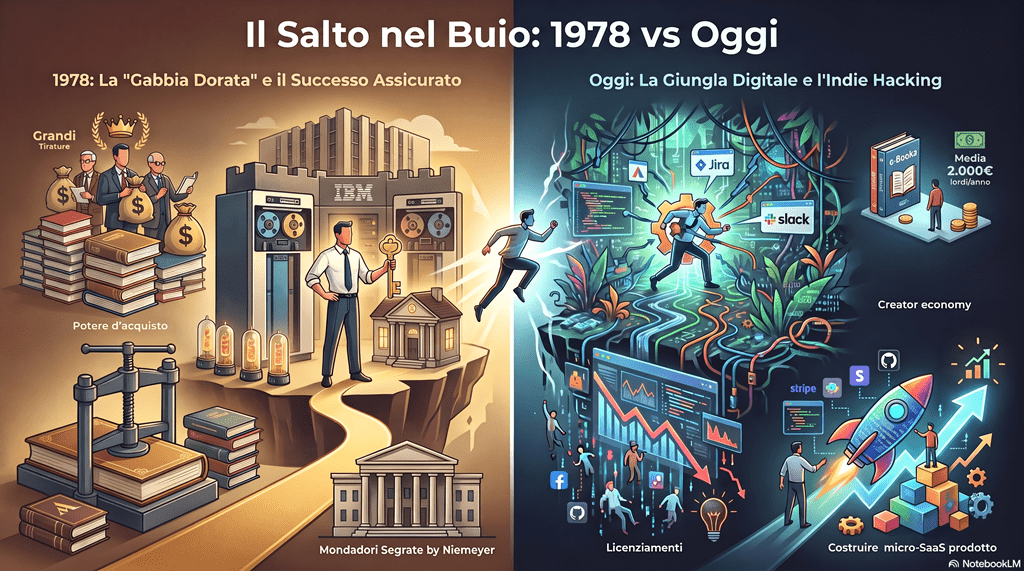
It is not about leaping into the void hoping that someone will publish you or hire you, but about building a digital safety net line by line, user by user, before unplugging from corporate life.
Many of today’s startups use this approach: people working at different companies who collaborate to create independent products. The indie hacker community is an ecosystem of mutual support, where sharing knowledge and resources becomes the new “elevator” in which to compare notes and grow.
The conscious leap manifesto: a checklist for the indie hacker
If the coin in your pocket is starting to burn and you’re entertaining the idea of making the big leap, make sure you’ve ticked these four boxes:
- The first Stripe notification test: Don’t quit based on an idea or a prototype that only you, your mum and ChatGPT’s system prompt think is great — they are all extremely biased parties. Wait until a stranger gives you real money. If no one is willing to pay to avoid doing manually what your software automates, you’ve built a beautiful (and expensive) hobby, not a business.
- Broke founders don’t use AWS: Keep infrastructure costs close to zero. If your side project is spending €300 a month on servers to handle 3 registered users (two of whom are your own test accounts and one is a Russian bot), you’re not an entrepreneur: you’re a philanthropist funding Jeff Bezos’s next space trip. Use free tiers, or €3-a-month servers, until you see revenue: skip one pizza a month for your idea.
- The “rent factor”: Calculate your survival expenses for at least a year. If quitting puts you just three months’ rent away from moving back in with your parents or living exclusively on instant ramen, performance anxiety will kill your code. The real parachute is built while you still have the warm seat of the corporation covering your back.
- The two-hours-at-night test: If after 8 hours of arguing with merge conflicts at the office you can’t find the energy to write half a line of code for yourself, don’t fool yourself: having 24 free hours a day won’t magically turn you into a productivity machine. You’ll just become an unemployed person scrolling TikTok for most of the day. Discipline is tested when time is scarce, not when you have too much of it.
A different choice, not an impossible one
The conclusion is not that freedom is dead, but that the rules of the leap have changed. The world that made Luciano De Crescenzo’s story possible no longer exists, and it is pointless to look for it. You can no longer jump into the void trusting in the generosity of the market or the solidarity of an industry that shows no mercy.
In 1978 the margin was wide and guaranteed from above: high salaries, affordable homes and an expanding market provided the net. Today we have to weave that net ourselves.
Jumping today without preparation is not an act of courage, it is a poorly calculated risk. But jumping having built your own independent ecosystem, leveraging AI to operate as a one-person company and diversifying your income streams, is the form of courage of our time.
If an IBM engineer today flips a coin in the elevator, they should not do so to choose between two forms of anxiety, but to decide whether the moment has come to bet on the product they built at night. And perhaps, that notification on their smartphone will not be a task assigned by a manager, but the first Stripe notification announcing that their independent software has just found a new customer.
De Crescenzo’s choice remains a lighthouse: it reminds us that work must serve life and creativity, and that when the cage (even a golden one) becomes too tight, the only sensible response is to find a way to open it.