There’s a moment in every Codemotion edition when we announce the name that opens the conference. This year that moment is worth telling properly.
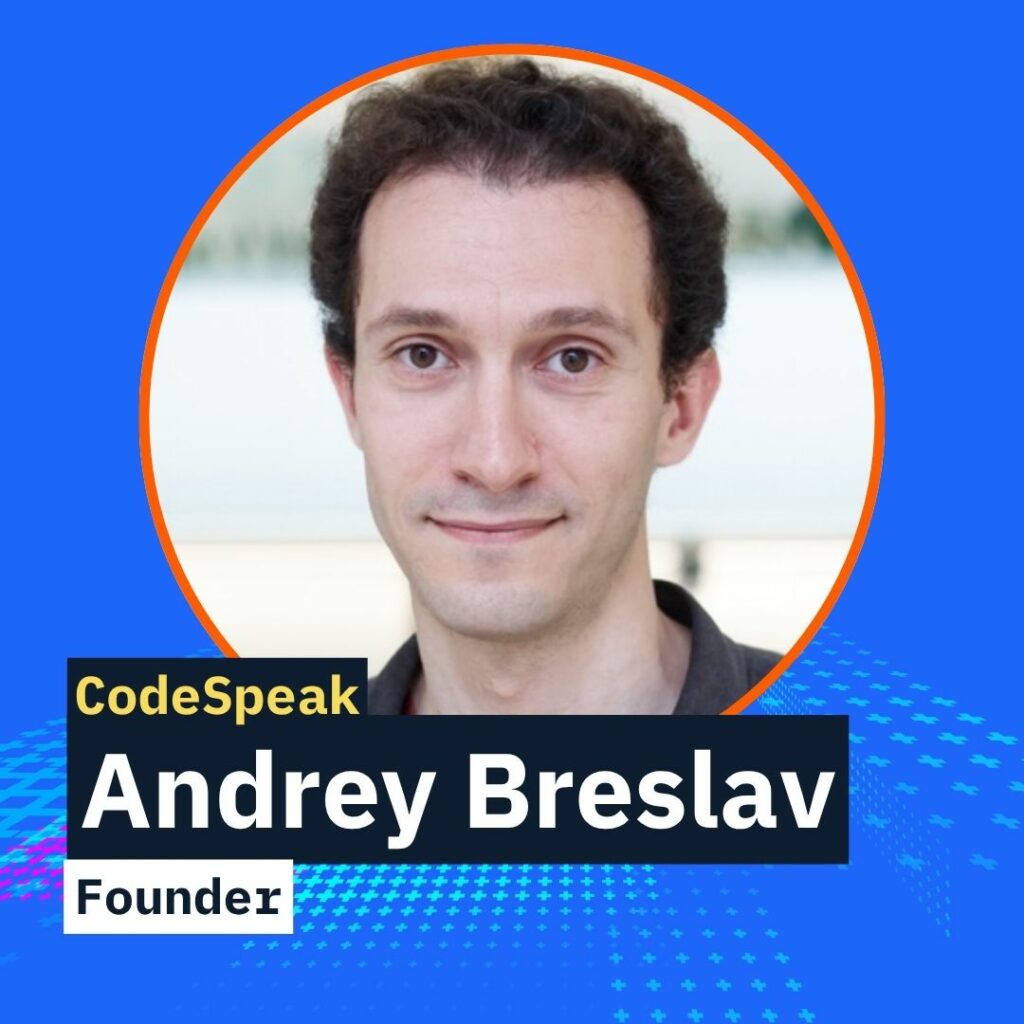
Andrey Breslav is the first confirmed keynote speaker for Codemotion Milan 2026.

If the name rings a bell, there’s a reason: he’s the man behind Kotlin, the language you’ve probably written, read, or argued about in a code review at least once this week. When it comes to people who have actually shaped how we write software today, few names carry this much weight.
This isn’t a casual pick, and it’s not just a headline name. At a moment when the AI-and-development debate is everywhere, often loud and rarely substantiated, we wanted to open the conference with someone speaking from a genuinely uncommon vantage point: he has already designed a programming language from scratch, taken it to global production scale, and is now tackling the same underlying question, what does it actually mean to write software, in the age of AI agents. Few people on earth have earned that perspective. We’re putting it on stage in Milan.
Who is Andrey Breslav
If you build for Android, you’ve almost certainly written Kotlin, or built something on top of a library born from it. Breslav created the language and led its development at JetBrains from 2010 to 2020: from the first design sketch on a whiteboard, drawn the same day as his job interview, to becoming Google’s official standard for Android development. Today Kotlin is used by over 7 million developers worldwide. Not just “a successful language”: one of the very few languages born in the last fifteen years to actually scale to that level.
That kind of arc, from the first line of design to mass adoption, through a decade spent leading teams and making calls that thousands of developers would feel every single day, teaches things you simply won’t find in a theoretical talk: what it means to evolve a language while keeping backward compatibility, how you manage a community growing by orders of magnitude, where design trade-offs get paid back with interest years later.
This is where the story gets interesting for anyone looking at AI with curiosity rather than slogans. Since 2025, Breslav has been founder and CEO of CodeSpeak, a spec-based AI coding platform. Instead of generating code from open-ended prompts and hoping for the best, CodeSpeak starts from structured specifications written in natural English that guide the generation, leaving the mechanical part to the machine and the part that actually requires judgment to the human. It’s a fundamentally different architecture from a typical vibe-coding tool, built by one of the few people who has already lived, at real scale rather than in a proof of concept, what happens when a coding tool has to hold up under millions of developers.
The keynote: where humans stand in a world of machine-written code
The opening talk is titled “Future of Programming: What’s our place in the world of coding machines?” The title alone gives away where this is headed. Not a reassuring tour of the latest tools, but an uncomfortable question asked by someone with every credential needed to ask it seriously, no flashy slides required.
The starting point is something every dev team is living through right now, even if it doesn’t always get said out loud: more and more code is generated by agents and LLMs, code review is struggling to keep pace with the volume, and building software has objectively gotten easier for more people, including plenty who wouldn’t call themselves “developers” in the traditional sense. So where, exactly, do human developers stand in this new balance?
Breslav doesn’t promise easy answers, which is exactly why it’s worth showing up. The talk takes on direct questions: can agents genuinely handle planning, coding, review, and testing on their own? What do human developers have that an LLM, as currently built, simply can’t replicate? And where should you actually be investing your energy and skills over the next few years, before the ground shifts again, as it already has more than once lately?
It’s not an optimistic keynote by default, nor an alarmist one on principle, and that balance is exactly what makes it worth attending. This is the analysis of someone building an AI-native product from a precise technical observation, not a pitch: an LLM has no internal model of correctness, no real understanding of the domain it’s working in, no persistent memory across sessions. A spec-based approach exists precisely to give agents something concrete to get wrong, and therefore something concrete to be corrected against. It’s a perspective grounded in the technology’s actual limits, not in the hype of the moment. Hearing it live will probably be worth the ticket on its own.
Why this talk matters for anyone working in software today
If your team is already using Copilot, Cursor, Claude Code, or similar tools in the daily workflow, you’ve probably already run into the questions Breslav will raise on stage: where to draw the line between automation and oversight, how code review changes when a growing share of the code wasn’t written by a person, which skills stay central once “knowing how to write code” stops being the main differentiator.
This isn’t a talk for anyone looking for easy validation about AI, in either direction. It’s built for people who have to make real decisions about how to structure teams, processes, and engineering practices over the next few years, with input from someone who has already lived through one paradigm shift in software development and is now building the next one in real time, while everyone else is still asking the question.
Andrey Breslav is the first name on the Codemotion Milan 2026 lineup, with more on the way. Find out more about the conference, the growing speaker lineup, and how to secure your spot.