An open source project combines computer vision, multimodal models, and local artificial intelligence to turn an ordinary mirror into an interactive fashion assistant, with no dependence on the cloud.
Mirrors have long been depicted as magical objects across popular fiction. They serve as portals to alternate worlds in Alice in Wonderland and The Matrix, clairvoyant windows in Snow White and Beauty and the Beast, a dating game showcase in Shrek, and a window into one’s deepest yearnings with the Mirror of Erised in Harry Potter.


To this gallery of magical artifacts, we wanted to add our own contribution, with a pinch (so to speak) of technology.
Imagine standing in front of a mirror that doesn’t just reflect your image, but can also analyze what you’re wearing and suggest how to improve your outfit. That’s the idea behind AI Smart Mirror, a project that explores the potential of Edge AI through the VENTUNO Q platform.
The solution combines visual recognition, AI models, and an interactive interface to deliver an experience that could be used in smart fitting rooms, next-generation retail, and connected home environments.
The project is available on GitHub and is based on the original Arduino Smart Mirror tutorial, with one significant change to the interaction: instead of a physical button, it uses a visual activation system that starts the analysis naturally and without contact.
Two AI Models to Understand What We See
The heart of the system is the collaboration between two AI components, each with a specific job.
The first is a custom vision model, built with Edge Impulse, an end-to-end platform for building and deploying machine learning models on edge devices, that analyzes the camera’s video stream. When it recognizes the visual class chosen as the trigger, it activates the mirror’s processing. This way, the application can wait for a specific visual signal before starting the analysis, without requiring any user intervention.
The second component is Qwen3-VL-4B-Instruct, a Vision-Language Model (VLM). Unlike a system that merely classifies images, a VLM can interpret visual content and produce natural language responses. In the project, the model receives a camera frame along with a prompt and generates the feedback shown next to the reflected image.
Combining the two models separates the initial detection from the more elaborate interpretation: first the system recognizes the signal that should activate it, then it analyzes the image and returns a response.
VENTUNO Q: Advanced Artificial Intelligence Directly on the Device
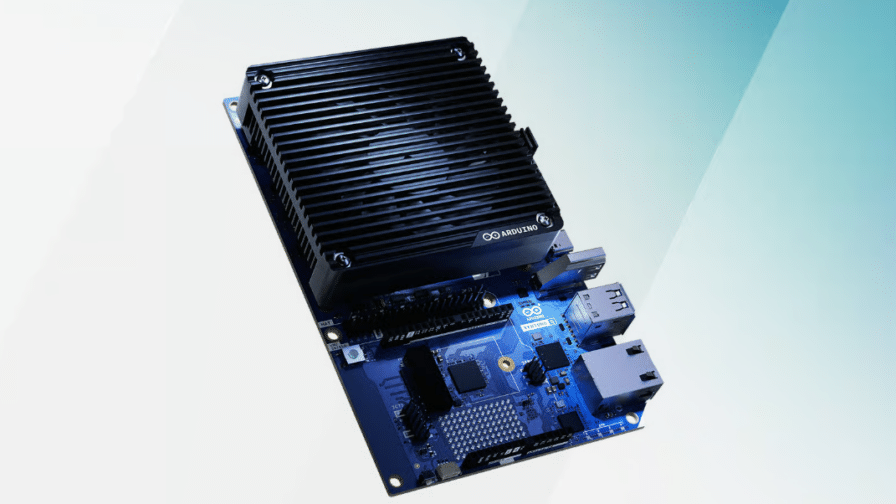
This architecture runs on VENTUNO Q, a platform designed for Physical AI, computer vision, and advanced robotics applications.
The board uses a dual-brain architecture. The Qualcomm Dragonwing™ IQ8 processor handles the most demanding workloads, including AI model inference, while the STM32H5 microcontroller is dedicated to deterministic control and tasks that require predictable response times.
This combination brings perception and control functions together on a single platform. Development happens through Arduino® App Lab, the environment that unites tools for programming, AI model integration, and application building.
In the Smart Mirror’s case, the software is built by combining App Lab Bricks, modular building blocks that handle image classification, frame capture, processing through the multimodal model, and displaying the results in a web interface.
Why Edge AI Makes the Difference
The most interesting aspect of the project isn’t just its use in the fashion sector, but how artificial intelligence is run.
In many applications, images are sent to a remote service that handles the processing and returns a response. With Edge AI, instead, inference runs directly on local hardware.
This approach offers several advantages:
- Less reliance on the network: AI processing doesn’t necessarily have to go through a cloud service, reducing the latency associated with remote communication.
- No recurring cost for cloud AI API calls: once the local models are set up, the application doesn’t pay a fee for each request sent to an external AI service, although other operating costs may remain.
- Greater control over data: camera frames can be processed locally without being sent to a remote AI service, an important advantage in contexts where privacy is critical.
- Greater operational autonomy: the system can keep using local models even without an Internet connection, as long as all the necessary resources are already on the device.
In the case of a smart fitting room, these aspects are particularly relevant: users can receive suggestions while trying on clothes without every image having to be uploaded to an external platform.
Of course, privacy also depends on the behavior of the application as a whole: any external services used for other functions must be evaluated separately.
From Tutorial to Contactless Interaction
AI Smart Mirror is an evolution of the original Arduino tutorial on the smart mirror. The most obvious change is the move from a physical button to a contactless visual trigger.
The classification model continuously observes the scene and activates the function when it recognizes the selected class for the required amount of time. At that point, the system captures the frame, sends it to the local VLM model along with the instructions, and displays the response in the interface.
Users can change both the class that triggers the mirror and the prompt used to formulate the request, directly from the browser. This makes the project interesting from an experimental standpoint too: you can adapt the application’s behavior without constantly having to modify the code.
The result is a smoother interaction, in which computer vision doesn’t just observe a scene but becomes the starting point for an AI-driven experience.
From Retail to Smart Home: Possible Applications
A system like this opens up several possibilities. In retail, a smart mirror could become part of an interactive fitting room able to offer information and advice while a customer tries on a garment. Local processing could also make it easier to design experiences that respect customer privacy.
In a smart home, the same principle can be adapted into a personal assistant built into your home mirror. By changing the classification model and the prompt, you can explore different interactions and develop new use cases.
In fact, this project represents a solid starting point for thinking and developing Edge AI-based solutions.
A Concrete Example of AI Moving from the Cloud to the Real World
AI Smart Mirror shows how Edge AI can turn artificial intelligence models into interactive tools embedded in a physical device. The combination of a custom classification model, a local Vision-Language Model, and a hardware platform designed for AI workloads makes it possible to experiment with a multimodal experience without relying on a remote service for the main processing.
The project’s value lies in this integration: not just a model capable of analyzing images, but a system in which video capture, recognition, response generation, and interface all work together.
For developers, makers, and companies interested in new interaction scenarios, it’s a concrete starting point for exploring more autonomous, responsive artificial intelligence applications that are mindful of data handling.
Learn More
- Open source project on GitHub: https://github.com/jimbruges/workshop-ventuno-q-smart-mirror/
- Arduino Smart Mirror tutorial: https://docs.arduino.cc/tutorials/ventuno-q/smart-mirror/
- VENTUNO: https://www.arduino.cc/product-ventuno-q/
- Edge Impulse https://www.edgeimpulse.com/
Qualcomm branded products are products of Qualcomm Technologies, Inc. and/or its subsidiaries.
Arduino, VENTUNO, and the Arduino logo are trademarks or registered trademarks of Arduino S.r.l.